Teams ask for AI search monitoring when a one-off query is not enough. They want recurring checks: Did this brand narrative shift? Did a competitor phrase spike on social? Did a research topic produce new papers this week? Did our docs still rank in the result set our agents see?
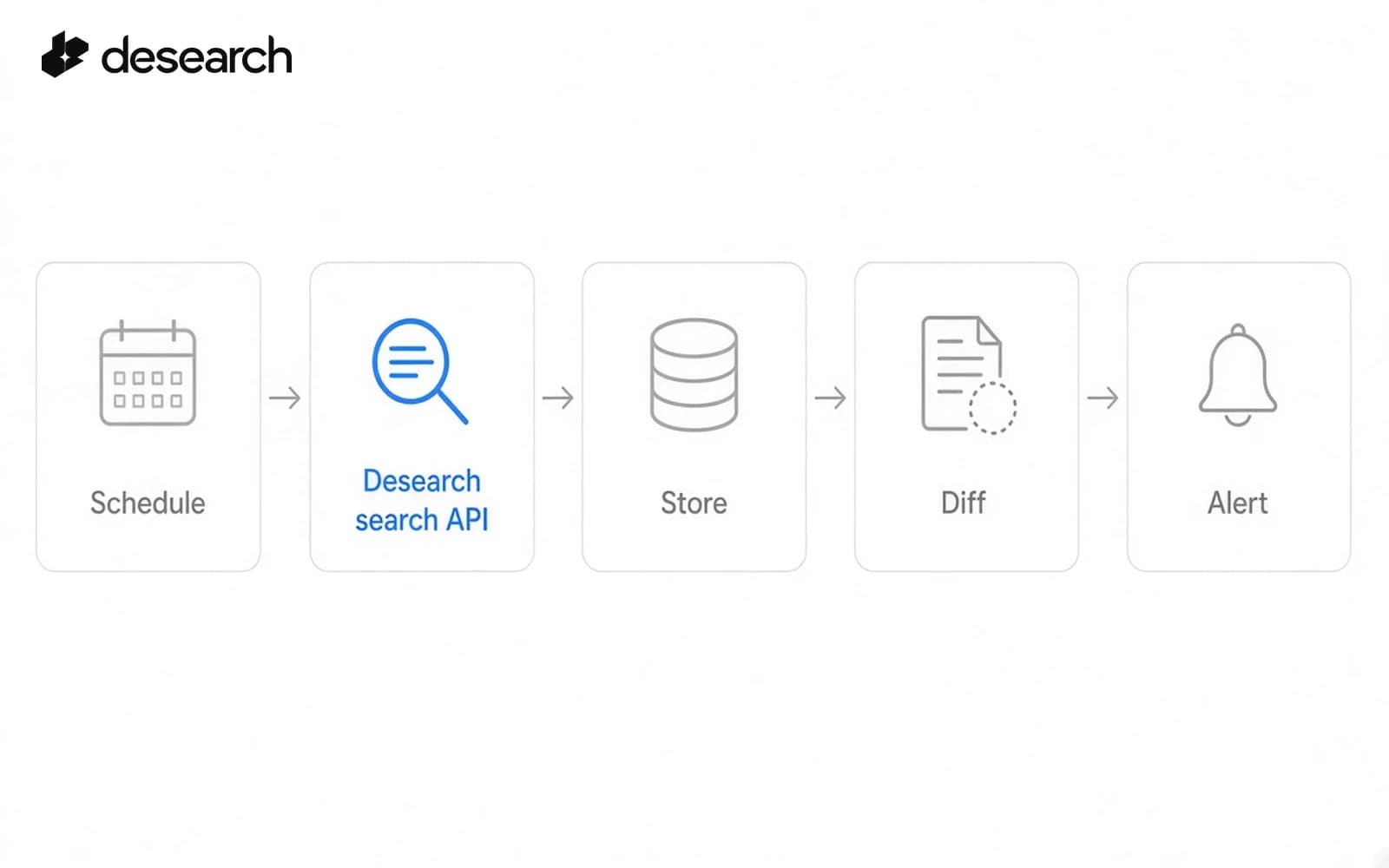
Desearch does not sell a separate "Monitoring" product SKU. What you can ship today is a workflow: schedule Desearch search API calls, store the results in your own systems, alert with tools you already trust, and use Console for keys, usage, and spend visibility.
This post is a practical blueprint for that workflow. It is not a latency / p95 operations guide, and it does not invent alert dashboards that do not exist.
What "AI search monitoring" means in this guide
In this article, AI search monitoring means:
- Recurring retrieval of fresh web, AI search, and/or social context via Desearch APIs
- Your own storage of responses (or normalized excerpts)
- Your own diff / threshold logic
- Alerts in your stack (email, Slack, Pager-style tools, tickets)
- Operational visibility via Desearch Console for API keys and usage / spend
If you need a hosted "monitor product" with built-in alert rules UI, that is outside what this guide claims. Build the loop; keep ownership of storage and alerting.
When this workflow is a good fit
Use a recurring Desearch check when:
- Your agents or analysts care about fresh context, not a static corpus
- You want the same prompt / tool mix replayed on a schedule
- You need citable sources (links, snippets, timestamps when returned)
- You already have a place to store JSON and fire alerts
Skip this pattern when:
- You only need a one-time research answer
- You expected a turnkey monitoring SKU with rule builders inside Desearch
- You are trying to turn this into a site-latency SRE console (wrong article)
Architecture overview
A minimal team loop looks like this:
Scheduler → Desearch API (web / AI / social search) → Store raw + normalized rows
       → Diff / score → Alert channel
       → Console (keys, usage, spend visibility)
Each box is deliberate:
- Scheduler: cron, GitHub Actions, Cloud scheduler, worker queue. Yours.
- Desearch API: the retrieval layer for live search context.
- Store: Postgres, object storage, a warehouse table. Yours.
- Diff / score: hash of top links, embedding distance, keyword hits, count of new domains. Yours.
- Alert: Slack webhook, email, ticket. Yours.
- Console: create keys, rotate secrets, watch usage and spend so the job does not surprise finance.
Step 1: Pick the search surface for each check
Desearch exposes search-oriented APIs you can call from backend jobs. Common building blocks (confirm shapes in current docs / OpenAPI before hard-coding):
- AI search style calls for a natural-language prompt plus a
toolslist (web and other sources your account can use) - Web search style calls when you want classic result pages / enrichment
- Social / X-oriented search when the signal lives in public conversation
Practical rule:
- Use one prompt per monitor (or a small versioned set)
- Keep the tool / source list stable so day-over-day diffs mean something
- Prefer link-heavy responses when you care about what appeared, and summaries only when a human will read the digest
Do not overload a single job with every source at max count "just in case." Monitoring costs scale with how often you call and how wide each call is.
Step 2: Schedule the calls (your scheduler)
Example cadence patterns teams actually use:
| Check type | Example cadence | Notes |
|---|---|---|
| Brand / narrative | Hourly or every few hours | Keep prompts tight |
| Research topic | Daily | Date filters help |
| Social chatter | Frequent, shorter window | Store ids / urls for dedupe |
| Agent regression prompt | On deploy + daily | Compare against a golden set |
Pseudo-shape for a job (language-agnostic):
every N minutes:
  response = desearch.search(prompt, tools, date_filter?)
  write_raw(run_id, response)
  features = normalize(response)   # titles, links, published dates
  previous = load_previous(monitor_id)
  delta = diff(previous, features)
  if delta.crosses_threshold:
      notify(team_channel, delta.summary)
  save_features(monitor_id, features)
Keep secrets in your job's secret store as DESEARCH_API_KEY. Never bake a live key into the repo.
Step 3: Store results yourself
Save enough to explain an alert later:
monitor_id,run_id,timestamp- request fingerprint (prompt, tools, filters, count)
- raw response (or compressed object pointer)
- normalized top links / titles / snippets
- optional billing metadata if the response exposes cost / usage fields or headers
Retention is a team policy. Raw JSON is useful for audits; normalized rows are better for diffs and cheap dashboards you build in-house.
Step 4: Alert in your stack (no fake Desearch alert product)
Desearch is the retrieval engine in this design. Alerting stays with you.
Simple thresholds that work without ML theater:
- New domain appears in top N links
- A tracked phrase appears / disappears
- Overlap with yesterday's link set drops below a percentage
- Result count collapses to empty / near-empty for a prompt that usually returns hits
Send a short alert:
- monitor name
- time
- what changed (3 to 5 links or phrases)
- link to your internal detail view
- optional deep link back to Console usage if spend spiked
Do not claim Desearch ships native threshold alerts, anomaly SKUs, or paging unless product docs explicitly say so. As of this writing, treat alerts as your layer.
Step 5: Use Console for keys, usage, and spend visibility
Console is where teams:
- Create and rotate API keys
- Keep production jobs on a dedicated key
- Watch usage and spend visibility so recurring checks stay intentional
Soft note: Console surfaces evolve. Do not assume a specific chart widget or "monitoring dashboard" tile. Use whatever usage / spend views your account currently shows, and export logs from your own store for deeper analytics.
For shared team ops:
- Separate keys for
playground,staging-monitors, andprod-monitors - Document owner + cadence next to each monitor id
- Cap schedule density until you understand cost per run
Example monitor pack (templates you can copy)
A) Brand narrative check
- Prompt: "What are people saying about {brand} and {topic} this week?"
- Tools: web + social sources you actually need
- Store top links + short excerpts
- Alert when a new high-signal domain or repeated claim appears
B) Research watch
- Prompt: "New papers or explainers on {topic}"
- Prefer sources like web + arxiv-style tools when available in your catalog
- Daily cadence
- Alert on new titles not seen in the last 7 days
C) Agent prompt regression
- Freeze a prompt your production agent uses
- Run it daily
- Diff top citations
- Alert humans when the citation set drifts beyond a threshold before you change agent behavior
These are workflows, not product modules.
Team operating habits
- Version the prompt. Treat monitor prompts like code.
- Deduplicate. Social and web results repeat; store canonical urls.
- Budget deliberately. Recurring jobs are where surprise spend appears.
- Separate research from paging. Not every delta deserves a night alert.
- Cite sources in digests. Monitoring without links trains bad decisions.
How this differs from one-off AI search
| One-off search | Recurring monitoring workflow |
|---|---|
| Answer a question now | Detect change over time |
| Human in the loop immediately | Job + storage + alert |
| Playground friendly | Scheduler + secrets hygiene |
| Optimize for completeness once | Optimize for stable, comparable runs |
If you are still learning the API shape, succeed in Console / Playground first, then promote the same request body into a scheduled job. For a related path from Console into agent loops, see the Desearch cookbook-style posts on the blog when published.
FAQ
Does Desearch offer an AI Search Monitoring product?
No dedicated Monitoring SKU is claimed here. This guide shows how to compose Desearch search APIs into a monitoring workflow.
Can Desearch send Slack alerts for me?
Not as a claimed built-in monitoring feature in this article. Wire alerts in your own stack after you store and diff results.
Which API should I call?
Match the check: AI search for prompt + tools, web search for classic results, social / X search when conversation is the signal. Confirm current endpoints and parameters in docs / OpenAPI.
Where do I see spend?
Use Desearch Console for keys and usage / spend visibility. Keep detailed monitor analytics in your own datastore.
Will this replace a full brand-listening suite?
Probably not by itself. It is a strong search-backed check layer for teams that already have orchestration and alerting.
Implementation checklist
- One monitor id, one versioned prompt, stable tool list
- Scheduler with backoff and failure alerts
- Secret-managed
DESEARCH_API_KEY - Raw + normalized storage
- Diff logic with an explicit threshold
- Alert route owned by the team
- Console key hygiene and spend review cadence
Next steps
- Pick one prompt worth watching daily.
- Run it manually until the response shape is boringly familiar.
- Schedule it.
- Store and diff for a week before you add more monitors.
- Watch usage in Console as you scale cadence.
AI search monitoring for teams is less about buying a new product category and more about operationalizing search: same Desearch retrieval you already trust, on a clock, with your storage and your alerts. Keep the loop honest, keep spend visible, and only page humans when the delta is real.